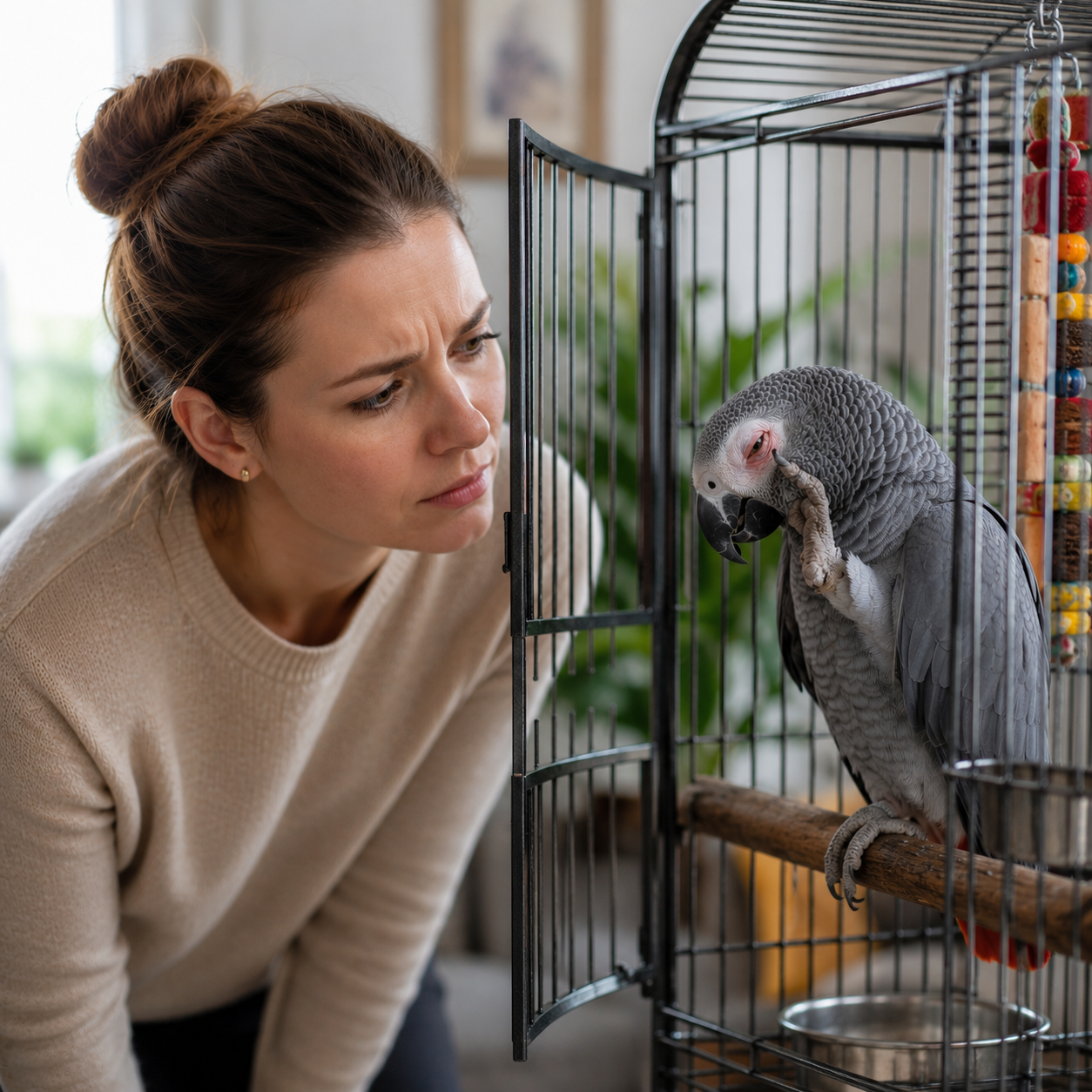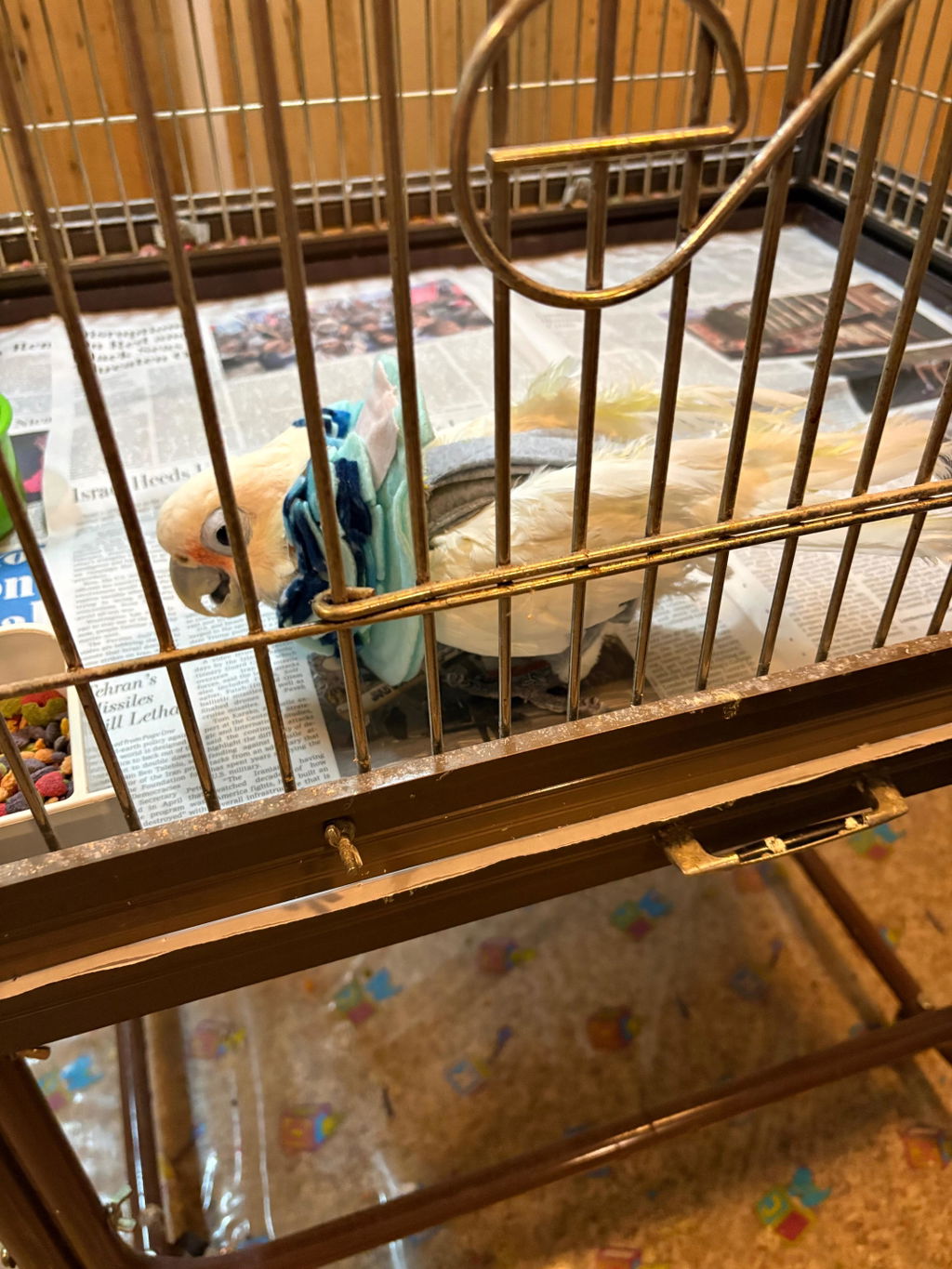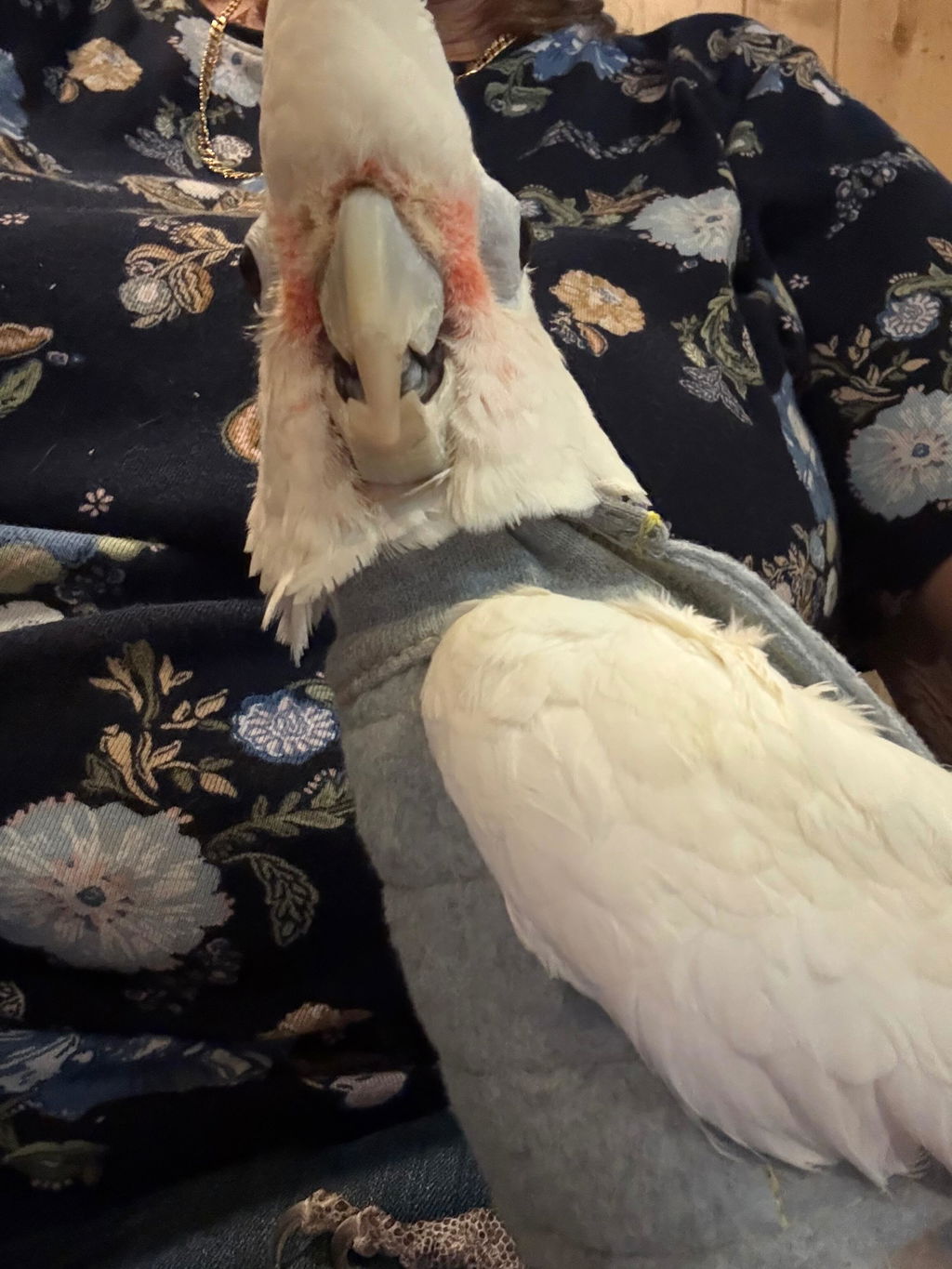

If you've noticed thinning feathers or a small bald area around your bird's eye, this guide is for you. We'll help you tell the difference between normal feather replacement and feather loss that may be related to rubbing, another bird, skin irritation, or a problem involving the eye or sinuses.
Quick answer: A few missing feathers around the eye can be normal during a molt, especially when the skin looks healthy and tiny new feathers are already growing in. A distinct bald patch, irritated skin, repeated feather loss, or changes in the eye itself suggest that something more than normal molting may be going on.
This article is meant for birds with localized thinning or feather loss around the eye. If your bird has significant eye swelling, discharge, obvious injury, bleeding, trouble breathing, or is keeping the eye closed, don't use this guide to wait it out — contact your avian veterinarian.
In This Guide
Is It Normal Molting or Something Else?
Because the feathers around a bird's face are so small, losing only a few can make the area suddenly look thin. The first thing to figure out is whether you're seeing normal feather replacement or a patch that is being repeatedly damaged.
Normal molt usually shows signs of new growth
During a healthy molt, facial feathers are shed gradually and replaced with new ones. You may notice tiny pin feathers — short, quill-like new feathers just beginning to grow — appearing where older feathers have fallen out.
Your bird should otherwise look and act normally, and over time the area should begin filling back in rather than becoming progressively more bare.
The skin and eye should still look healthy
The exposed skin during a normal molt should look relatively smooth and calm. Redness, swelling, sores, crusting, flaky buildup, or moisture around the eye point away from simple feather replacement.
Check the eye itself, too. A bright, open eye is reassuring, while tearing, discharge, swelling, repeated blinking, or squinting deserves more attention.
A growing bald patch is not typical
A clearly defined bare spot that keeps expanding, repeatedly loses feathers in the same place, or shows no evidence of regrowth is less consistent with routine molting.
The important question isn't simply whether feathers are missing. It's whether they're being normally shed and replaced or whether something is repeatedly damaging the feathers or the skin underneath them.
Does This Look Like Normal Molting?
Look at the feathers, skin, eye, and your bird's behavior together — not the bald spot alone.
| Looks More Like Normal Molt | Watch More Closely | Call Your Avian Vet |
|---|---|---|
| Healthy-looking skin | Bald area is getting larger | Skin is red, swollen, crusty, or sore |
| Bright, open eye | No obvious signs of new feather growth | Eye is watery, swollen, or producing discharge |
| New pin feathers are growing in | Bird keeps rubbing or scratching the area | Bird is squinting or keeping the eye partly closed |
| Bird is eating, active, and acting normally | The same area keeps losing feathers | Sneezing, nasal discharge, or breathing changes appear |
| Area gradually begins filling back in | Another bird repeatedly preens the same spot | Appetite, activity, or behavior changes |
Keep in mind: This table can help you organize what you're seeing, but it can't diagnose the cause. If eye symptoms or other signs of illness are present, contact your avian veterinarian.
What Can Cause Feather Loss Around a Bird's Eye?
Once normal molting seems less likely, the next step is to consider what might be disturbing the feathers in that particular area. Around the eye, rubbing, discomfort, and another bird's grooming behavior are especially important possibilities.
Rubbing and scratching can damage facial feathers
Most parrots can't easily reach the feathers around their own eyes with their beak, so a bald patch on the face is less typical of classic self-plucking. They can, however, scratch the area with a foot or repeatedly rub their face against a perch, toy, or cage surface.
If the area feels itchy or uncomfortable, that repeated friction can break or remove the tiny facial feathers. In this situation, the bald spot may be a clue to the real problem — whatever is making your bird want to rub or scratch.
Eye or sinus problems can affect nearby feathers
Tearing, discharge, swelling, or irritation can leave the feathers surrounding the eye damp, matted, or repeatedly disturbed. Because a bird's eyes, nostrils, and sinuses are closely connected, a problem that starts elsewhere in the face can sometimes show up around the eye.
If feather loss is paired with a watery or swollen eye, squinting, sneezing, nasal discharge, or breathing changes, the feather loss may be secondary to an eye or sinus problem rather than a feather problem by itself.
Another bird may be overpreening the area
Birds that live together often preen one another, and gentle mutual grooming is normal social behavior. Occasionally, though, one bird becomes too persistent and repeatedly breaks or removes feathers from a companion's head or face.
If your bird has a companion, watch their interactions. One bird repeatedly working the exact same area can be an important clue that the feather loss is coming from overpreening or barbering.
Could It Be a Skin Problem, Infection, or Mites?
If the exposed skin itself looks abnormal, the problem may involve the skin or feather follicles rather than simply missing feathers. Redness, scaling, crusting, or changes around the nostrils and beak can help point you in a different direction.
Irritated or infected skin can affect feather growth
Inflammation around a feather follicle can interfere with normal feather growth and may also make your bird more likely to scratch or rub. Redness, swelling, sores, tenderness, or persistent crusting suggest that the skin itself needs attention.
Different skin and follicle problems can look surprisingly similar at home, so appearance alone usually isn't enough to tell you exactly what's causing the problem.
Mites are possible, but they're not the usual cause
Bird owners often suspect mites when they see a bald or irritated patch, but mites are not a common explanation for localized feather loss in most pet parrots. Scaly face mites are more strongly associated with species such as budgies and may also occur in cockatiels and lovebirds.
Rather than causing only a smooth bald patch, mite problems are more likely to produce visible changes such as scaling, crusting, thickening, or roughened skin around the face, beak, nostrils, or legs.
Crusting and scaling offer important clues
Look at the skin around the eye, nostrils, cere — the area of skin around the nostrils at the base of the upper beak — and the beak itself. Flaky or thickened skin, unusual texture, persistent crusts, or redness are more suggestive of a skin problem than an uneven molt.
Avoid applying mite treatments, creams, oils, or medications based on appearance alone, especially this close to the eye. An avian veterinarian can determine whether the problem involves the skin, feather follicles, eye, or another nearby structure.
What Else Should I Look For?
Once you've looked at the bald area itself, take a minute to look at your bird as a whole. A few additional observations can help separate an isolated feather issue from a problem involving the eye, sinuses, skin, or overall health.
Check the eye and surrounding skin
Look for redness, tearing, swelling, discharge, repeated blinking, squinting, or an eye that isn't staying fully open. Also notice whether the exposed skin looks smooth and healthy or irritated, crusty, flaky, or swollen.
Look at the feather pattern
New pin feathers are encouraging because they show that the follicles are producing replacement feathers. Broken feathers, repeated damage to the same area, or feather loss appearing elsewhere on the body provide a different set of clues.
Also notice whether your bird is rubbing or scratching the area or whether a companion bird is repeatedly preening it.
Watch for whole-bird changes
Pay attention to appetite, activity, vocalizing, sleep, and normal social behavior. A bird that becomes quieter, eats less, sleeps more, or simply doesn't seem like themselves may be showing you that the problem isn't limited to a few missing feathers.
Sneezing, nasal discharge, noisy breathing, or other respiratory changes are especially important because they may indicate involvement of the sinuses or respiratory tract.
When Should I Call an Avian Veterinarian?
Not every uneven patch of facial feathers is an emergency. The decision comes down to what the skin and eye look like, whether new feathers are growing, and whether the area is stable or continuing to change.
Some feather loss can be watched closely
A small area of thinning may be reasonable to observe when the skin looks completely healthy, the eye is bright and normal, your bird is acting normally, and new pin feathers are already appearing.
Take a clear photo so you have something to compare over the next several days. That makes it much easier to tell whether the area is filling in, staying the same, or becoming larger.
Call when the area is changing or other symptoms appear
Contact your avian veterinarian if the bald area continues to expand, repeatedly loses new feathers, or develops redness, swelling, crusting, sores, or other changes to the skin.
Eye discharge, squinting, repeated rubbing, sneezing, nasal discharge, breathing changes, appetite changes, or unusual behavior also lower the threshold for calling.
Some signs are more urgent
Because the feather loss is so close to the eye, significant swelling, eye discharge, obvious trauma, bleeding, signs of pain, or a bird holding the eye closed deserve prompt veterinary attention.
If your bird is having trouble breathing, suddenly becomes weak or very quiet, or otherwise appears seriously ill, treat the situation as urgent.
Could Diet Play a Role?
Diet usually isn't the first explanation for one isolated bald spot, but good nutrition does matter for normal skin, feather, eye, and sinus health. Nutrition becomes especially relevant when feather quality is poor more generally or a bird eats a predominantly seed-based diet.
Vitamin A supports healthy tissues
Vitamin A helps maintain the normal tissues of the eyes, mouth, sinuses, and respiratory tract and supports normal skin and feather health. Birds eating mostly seeds are at greater risk of inadequate vitamin A because seeds are naturally low in this nutrient.
That doesn't mean a bald patch around the eye is automatically a vitamin A problem. Nutrition is one piece of the bigger picture and should be considered alongside what you see in the skin, eye, feathers, and overall bird.
Think balanced diet rather than one nutrient
A quality formulated diet combined with bird-safe vegetables provides a broader range of nutrients needed for healthy feather growth. Dark leafy greens, broccoli, sweet potato, carrots, and red peppers are examples of foods that provide beta-carotene and other beneficial plant nutrients.
Avoid concentrated vitamin A supplementation unless your avian veterinarian recommends it. More is not necessarily better, and excessive vitamin A can be harmful.
Looking to support vitamin A intake? UnRuffledRx Red Palm Oil provides naturally occurring provitamin A carotenoids along with vitamin E and fatty acids to complement a balanced parrot diet.
Nutrition supports health but doesn't diagnose the bald spot
Improving your bird's diet can support healthy skin and feather growth over time, but it won't tell you why feathers are disappearing from one particular area. Rubbing, skin disease, eye irritation, sinus problems, or another bird may still need to be addressed separately.
Will the Feathers Grow Back?
In many cases, yes. If the feather follicles remain healthy and whatever caused the feather loss is corrected, the feathers around your bird's eye can often grow back normally.
Healthy follicles usually allow normal regrowth
Feathers grow from follicles in the skin, so regrowth depends on those follicles remaining healthy. When feathers are lost during a normal molt or because of temporary irritation that has resolved, replacement feathers can usually grow with the bird's normal feather cycle.
The area may remain thin for a while, though. Feather regrowth doesn't necessarily begin immediately after the original feathers disappear.
Pin feathers are a reassuring sign
Small new pin feathers appearing in the bare area usually mean the follicles are actively producing replacements. As those feathers mature and open, the area should gradually begin to look fuller.
Avoid picking at or trying to open pin feathers around the eye. New feathers are delicate while growing and can be uncomfortable if disturbed.
Repeated damage can interfere with regrowth
Chronic rubbing, scratching, overpreening, or repeated injury can damage new feathers before they have a chance to mature. More significant or long-standing damage to a follicle can also affect how normally that feather grows back.
The goal isn't simply to make the feathers grow faster. It's to identify why they were lost and give healthy follicles the opportunity to produce normal replacement feathers.
This version also quietly teaches three concepts a newer bird owner may not know: **what a pin feather is, what the cere is, and why facial feather loss is different from classic self-plucking**. Those additions make it more educational without making it feel heavier.
Related Bird Health Guides
A Closer Look at Bird Eye Infections
Vitamin A Deficiency in Parrots
How to Find an Avian Veterinarian
How to Set Up a Hospital Cage for a Sick Bird
References
Merck Veterinary Manual. Eye Disorders of Pet Birds.
Merck Veterinary Manual. Nutritional Diseases of Pet Birds.
Merck Veterinary Manual. Bacterial Diseases of Pet Birds.
Merck Veterinary Manual. Parasitic Diseases of Pet Birds.
Merck Veterinary Manual. Management of Pet Birds.
About the Author
Diane Burroughs, LCSW, founded BirdSupplies.com in 1998 and has more than 30 years of hands-on experience with companion parrots. Her work focuses on avian behavior, nutrition, feather health, and practical care that helps bird owners recognize problems and take the right next step. This article is educational and is not a substitute for diagnosis or treatment by an avian veterinarian. Last reviewed July 2026.
SHARING IS CARING! PLEASE SHARE ON YOUR FAVORITE SOCIAL MEDIA NOW!